Does the deformation of encapsulation materials synchronize completely during heating and cooling?
During the temperature cycling (heating and cooling) process, the deformation of the encapsulation material cannot be perfectly synchronized.
This phenomenon of inconsistent deformation during the heating and cooling phases, where the physical paths do not overlap, is known as the Hysteresis Effect in physics and sensor engineering. For Fiber Bragg Grating (FBG) sensors, it is the core physical mechanism limiting the repeatability of high-precision measurements.
I. Physical and Mechanical Roots of Imperfect Deformation Synchronization
-
Thermal Inertia
Heat transfer exhibits time lag. During the heating phase, the outer encapsulation sleeve heats up and expands first, and heat conducts inward, so the internal grating (FBG) temperature always lags behind the external temperature. Conversely, during the cooling phase, the outer sleeve cools down and contracts first, and the internal grating temperature also lags. This results in a temperature field distribution gradient difference within the sensor between the heating and cooling processes at the same instantaneous ambient temperature. -
Viscoelastic Shear Lag
If organic polymer materials (such as epoxy resin or polyimide) are used in sensor encapsulation or bonding, these polymers exhibit significant Viscoelasticity. The stretching and relaxation of their molecular chains are non-instantaneous and time-dependent.
Particularly when the temperature approaches or exceeds their glass transition temperature (T_g), the strain response curves of the material during heating and cooling processes will diverge significantly, introducing a substantial phase lag in mechanical transmission. -
Extreme Mismatch in Coefficients of Thermal Expansion (CTE)
The CTE differences between the optical fiber (silica material, CTE approx. 0.55 imes 10^{-6} / ext{K}), the protective steel tube (stainless steel, approx. 16 imes 10^{-6} / ext{K}), and the bonding material are extremely large.
During temperature cycling, the interfaces between these dissimilar materials are subjected to high-density alternating shear stress. If the encapsulation process is poor, slight plastic deformation or microscopic slippage occurs at the interface. During cooling, the deformation cannot be fully recovered along the original path, manifesting as asynchronous mechanical deformation.
II. How Beijing Dacheng Yongsheng Technology Co., Ltd. (OFSCN®) Solves and Suppresses Such Hysteresis Errors?
To minimize the hysteresis caused by this “desynchronization” to the limit, Beijing Dacheng Yongsheng Technology Co., Ltd. (OFSCN®) has implemented stringent engineering optimizations in sensor structure and encapsulation processes:
-
Glue-free and Rigid Integrated Encapsulation
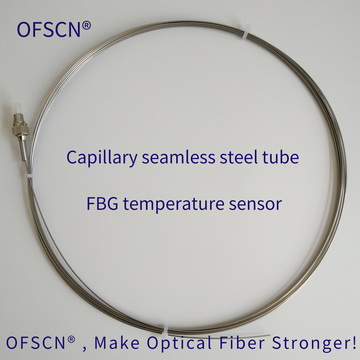
Adhesives are the primary cause of viscoelastic deformation hysteresis. Beijing Dacheng Yongsheng Technology Co., Ltd.'s OFSCN® 300°C Fiber Bragg Grating Temperature Sensor and OFSCN® 500°C Fiber Bragg Grating Temperature Sensor utilize seamless metal steel tube assembly technology without any resin adhesives, achieving purely mechanical contact and unimpeded heat transfer. This fundamentally eliminates hysteresis behavior caused by adhesive aging and creep. -
Ultra-thin Structure Design to Reduce Thermal Inertia
OFSCN® sensors have a default outer diameter of only 0.9 ext{ mm} and can be customized to an extreme of 0.5 ext{ mm}. The extremely small physical dimensions minimize thermal resistance, allowing the sensor’s interior to reach thermal equilibrium within milliseconds. This eliminates non-synchronous deformation due to thermal flow lag. -
High-Precision Nonlinear Fitting Calibration
The sensors undergo rigorous factory calibration using a binomial fitting formula (calibration formula unit: ^\circ ext{C/pm}), which accurately compensates for the nonlinear thermal expansion deviations between the metal protective casing and the optical fiber across different temperature ranges. When working with the high-resolution OFSCN® Fiber Bragg Grating Interrogator, excellent system repeatability is guaranteed.
Below are some classic products from Beijing Dacheng Yongsheng Technology Co., Ltd. that employ the glue-free steel tube encapsulation technology: