Why is there a slight mismatch in wavelength when heating and cooling to the same point?
In sensor metrology, the phenomenon where the Fiber Bragg Grating (FBG) reflection center wavelength (\lambda_B) measured at the same physical set temperature point during a heating process (positive travel) and a cooling process (return travel) do not perfectly overlap, exhibiting a slight deviation, is known as Hysteresis Effect, and its maximum deviation is the Hysteresis Error.
An FBG’s reflection wavelength is determined by its effective refractive index n_{\text{eff}} and grating pitch \Lambda:
\lambda_B = 2 n_{\text{eff}} \Lambda
Bulk pure fused silica exhibits extremely high thermo-elastic recovery precision within its elastic limit, thus the intrinsic material hysteresis of a pure bare grating is minimal. The wavelength hysteresis observed during heating and cooling tests is primarily caused by the following four physical and engineering packaging mechanisms:
1. Viscoelastic Creep of Encapsulating Adhesive Layers (Most Common Primary Cause)
If polymers (e.g., epoxy resin, silicone gel) are used in sensor fabrication to fix the grating or fill the outer casing:
- Polymer materials exhibit typical Viscoelasticity. During heating, the adhesive expands and generates micro-stresses. During cooling and contraction, the recovery of molecular chain segments requires relaxation time, preventing instantaneous and complete restoration to the original configuration.
- Strain relaxation and micro-creep in the adhesive layer are transmitted to the fiber via interfacial shear forces. This results in residual axial micro-strains in the fiber core during cooling that differ from those during heating, leading to wavelength inconsistencies at the same temperature.
2. Residual Stress Hysteresis Due to Mismatched Coefficients of Thermal Expansion (CTE)
- The CTE of fused silica fiber is extremely low (approx. 0.5 \times 10^{-6}\ /\text{K} ), while that of the external metal protective casing (e.g., stainless steel is approx. 16 \times 10^{-6}\ /\text{K} ) is significantly higher.
- During thermal cycling across a wide temperature range, micro-slip at the interface between dissimilar materials and asynchronous release of micro-strains during the heating and cooling of structural components can cause mechanical hysteresis.
3. “Dynamic Thermal Hysteresis” Caused by Heat Transfer Time Constants (Measurement Method Factor)
- Thermal resistance and thermal capacitance exist between the sensor’s protective casing, internal filling medium, and the fiber core, establishing a fixed thermal time constant (\tau).
- If the heating or cooling rate is too fast, insufficient time is allowed for the sensing core to reach a state of complete thermal equilibrium:
- Heating process: The actual temperature of the fiber core lags behind the external setpoint (core is colder, wavelength is shorter);
- Cooling process: The fiber core’s heat dissipation lags behind the external setpoint (core is hotter, wavelength is longer).
In this scenario, even if the temperature shown by the thermostat is the same, there is a slight actual temperature difference within the fiber core during positive and return travel, leading to wavelength deviation.
4. Micro-aging and Rearrangement of Fiber Coating
- If the FBG measurement point retains its original acrylate coating, when the operating temperature exceeds the coating’s glass transition temperature or under prolonged heating, the coating material can undergo micro-plastic deformation and residual stress reconstruction, causing irreversible or slowly recoverable micro-wavelength shifts.
How to Minimize or Eliminate Hysteresis Effects
- Sufficiently Extend Isothermal Holding Time: During calibration or precision measurements, each test point must be held at a constant temperature for a duration several times longer than the sensor’s time constant (typically \ge 5\tau) to eliminate transient thermal hysteresis.
- Thorough Temperature Pre-cycling and Annealing: Newly manufactured sensors should undergo multiple full-range alternating high and low temperature cycles before use to release residual stresses within the packaging structure.
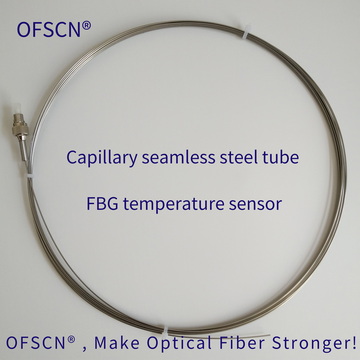
- Adopt Low-Creep, Seamless Metal Encapsulation Structures: Avoid using easily creepable polymer adhesives in the temperature-sensing zone. For example, Beijing Dacheng Yongsheng Technology Co., Ltd.'s OFSCN® 300°C Fiber Bragg Grating Temperature Sensor, utilizing proprietary seamless steel pipe mechanical packaging technology, achieves maximum suppression of strain hysteresis caused by adhesive viscoelastic relaxation and enhances thermal cycling repeatability through its all-metal micro-casing protection and purely physical strain decoupling design.