Why do regular patch cords lose signal when slightly pulled or pressed by a chair?
Standard fiber optic patch cords, when subjected to pulling or being run over by heavy objects (such as people, chair casters, etc.), will experience instantaneous signal interruption or permanent physical damage. From the perspectives of optical engineering and solid-state physics, this “noodle-like fragility” is determined by a combination of the inherent physical limitations of the material itself and the mechanical structural defects of ordinary patch cords.
I. Physical Material Characteristics: The Brittle Nature of Silicon Dioxide
The core medium of ordinary optical fibers is high-purity silicon dioxide (SiO_2) glass. The structural parameters of standard single-mode fiber are as follows:
- Core Diameter: Approximately 9\ \mu\text{m}
- Cladding Diameter: Only 125\ \mu\text{m} (equivalent to the thickness of a human hair)
While silicon dioxide glass theoretically possesses extremely high tensile strength along the axis, as a typical inorganic non-metallic brittle material, its surface inevitably has microscopic cracks (Griffith Microcracks) at the nanoscale.
- Tensile Stress Failure: When subjected to instantaneous pulling, stress concentrates rapidly at these microcracks. Once the local strain exceeds the limit strain of the glass (typically around 1\ \% for standard fiber screening tests, corresponding to about 100\ \text{kpsi} or 0.7\ \text{GPa}), the cracks propagate within the glass at the speed of sound, leading to instantaneous brittle fracture of the fiber without plastic deformation.
- Bending Loss (Macrobending Loss): When pulled or bent, if the bending radius of the fiber is less than the critical bending radius (for standard G.652D fiber, a bending radius R \ge 30\ \text{mm} is usually required), the light beam cannot satisfy the condition of Total Internal Reflection at the core-cladding interface, causing significant light leakage into the cladding. Physically, this manifests as Macrobending Loss, leading to a drastic drop in received optical power and resulting in a “no signal” condition.
II. Mechanical Structural Defects of Ordinary Patch Cords
Ordinary network cables or power cords contain multiple strands of copper wire internally. Copper has excellent ductility; when compressed, it may undergo plastic deformation at most, but it hardly affects the electrical signal continuity. However, the protective layers of ordinary fiber optic patch cords are extremely weak.
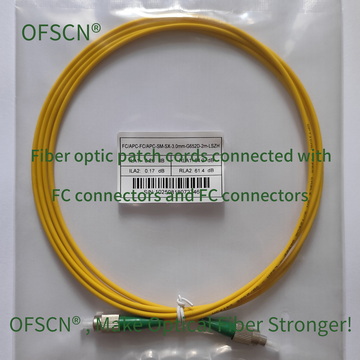
Taking the common OFSCN® Standard Fiber Patch Cord as an example, its cross-sectional structure from outside to inside is:
- Outer Jacket: Typically made of soft PVC or LSZH (Low Smoke Zero Halogen) plastic, with a diameter of 2.0mm or 3.0mm.
- Tensile Strength Element: A small amount of aramid yarn (Kevlar). Although aramid yarn can share some of the tensile force, it is essentially a soft fiber and provides no radial (lateral) support.
- Tight Buffer/Bare Fiber: The silicon dioxide glass enclosed within.
When run over by a chair or stepped on by a heavy object:
- Concentrated load (Point Load) acts directly on the extremely thin glass fiber through the soft PVC jacket.
- Due to the lack of a rigid radial skeleton, the PVC and aramid yarn cannot dissipate the stress, causing the fiber to experience intense local lateral shear and bending stress.
- This not only instantly causes significant Microbending Loss but also, when the concentrated compressive stress exceeds the limit compressive strength of the glass cladding, the core directly undergoes physical fracture.
III. Industrial-Grade Solution: Armored Physical Protection
To solve the problem of fiber being “fragile like noodles” in harsh environments where pulling, stepping, crushing, or rodent damage may occur, an armored protection structure must be introduced. By using high-strength rigid structures such as seamless stainless steel tubes as a physical barrier, the internal optical fiber is kept in a “zero-stress” state.
Beijing Dacheng Yongsheng Technology Co., Ltd. (OFSCN®) offers the following armored fiber optic patch cord solutions for different mechanical stress environments:
1. Micro Metal Protection Structure
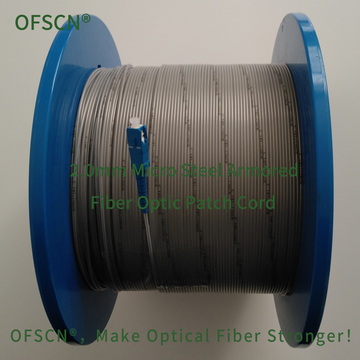
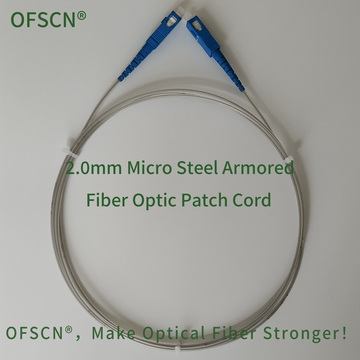
OFSCN® 2.0mm Micro Steel Armored Fiber Optic Patch Cord
This patch cord adds a layer of seamless stainless steel tubing with a diameter of only 0.6\ \text{mm} inside the traditional PVC jacket.
- Physical Mechanism: The high elastic modulus and yield strength of the steel tube can completely bear and dissipate external lateral concentrated loads (such as chair pressure). External pressure is shielded by the steel tube, and the internal fiber does not bear any radial or lateral force, thus achieving high compressive strength (> 240\ \text{MPa}) and high tensile strength (> 150\ \text{N}).
2. Heavy-Duty Protection Structure
For more extreme pulling and stepping environments, a stranded steel wire armor structure can be used:
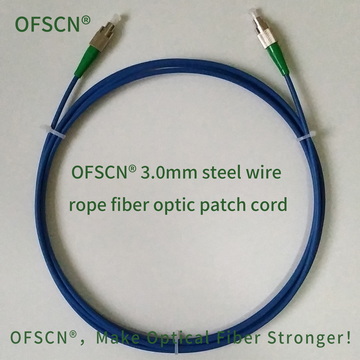
- OFSCN® 3.0mm Steel Wire Rope Fiber Optic Patch Cord (Stainless steel wire stranded structure + 0.9\ \text{mm} seamless stainless steel tube, tensile strength > 1200\ \text{N}, compressive strength > 200\ \text{MPa}).
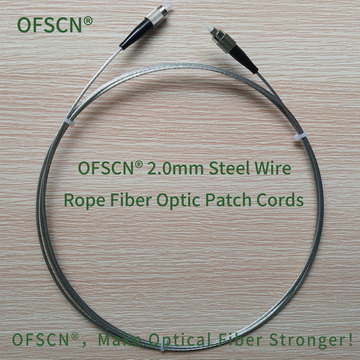
- OFSCN® 2.0mm Steel Wire Rope Fiber Optic Patch Cord (All-metal, jacketless structure, using a combination of 0.6\ \text{mm} galvanized steel wire stranding and 1.0\ \text{mm} seamless stainless steel tubing).
Conclusion
The “fragility” of ordinary patch cords is the inevitable physical result of the superposition of high brittleness of silicon dioxide material and a non-rigid plastic jacket structure. To completely avoid signal failure caused by pulling and crushing, armored patch cords with stainless steel seamless tube protection are the fundamental solution that conforms to the principles of mechanical protection.